The 1-1-1 Rule for Clearer LinkedIn Company Page Content
Most LinkedIn Company Page content does not fail because the idea is bad. It fails because the post is trying to do too much.
One post tries to speak to multiple audiences, explain several problems, promote a product, share a report, add proof points, include a call to action and keep every internal stakeholder happy.
The result is content that may contain useful information, but feels hard to follow.
That is a problem because buyers do not work hard to understand your content. They scan, make a quick judgement and decide whether to keep reading or move on. If the message is unclear, they move on.
This is where the 1-1-1 rule helps.
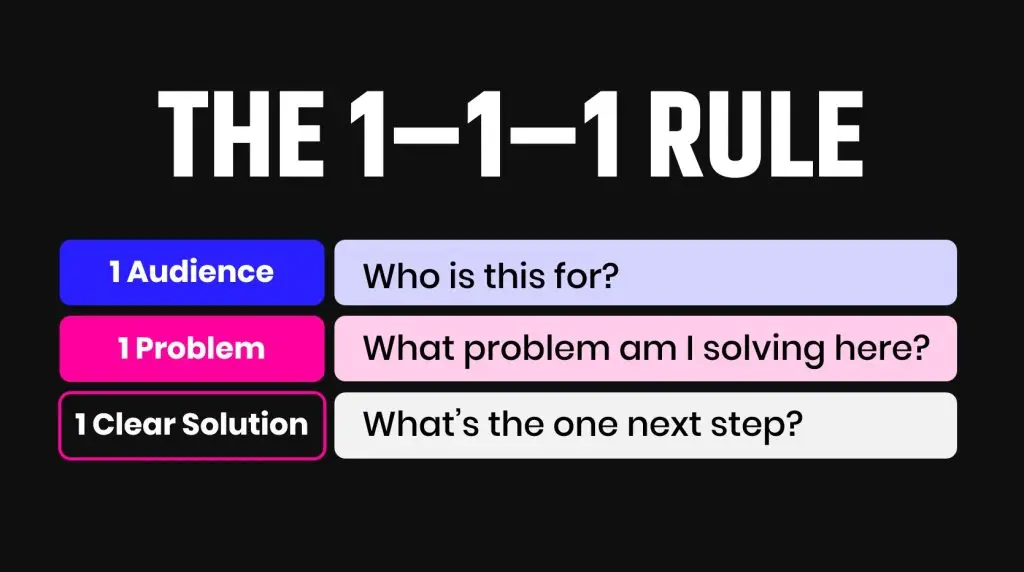
The 1-1-1 rule means one audience, one problem and one clear solution. It is a simple way to make LinkedIn Company Page content easier to understand, easier to engage with and more useful for the buyer.
For B2B brands, this matters because clarity is not just a writing issue. It is a strategy issue.
What Is the 1-1-1 Rule for LinkedIn Company Page Content?
The 1-1-1 rule is a simple content filter for creating clearer LinkedIn Company Page posts.
It asks you to focus each post on:
- One audience
- One problem
- One clear solution
That might sound basic, but it is where many Company Pages fall down.
Instead of creating one focused message, they try to fit everything into a single post. The product team wants features included. Sales wants a customer problem mentioned. Marketing wants the campaign message added. Leadership wants the brand line included. Someone else wants the report linked.
By the time the post goes live, the original idea has become too heavy.
The 1-1-1 rule gives you a way to simplify before you publish. It helps you ask whether the post is clear enough for someone outside your business to understand quickly.
If you cannot clearly say who the post is for, what problem it solves and what the one takeaway is, the content is not ready yet.
Why LinkedIn Company Page Content Becomes Unclear
Company Page content often becomes unclear because it has too many jobs.
This is especially common in B2B, where products can be complex, buying committees are bigger and internal stakeholders all have different priorities. The temptation is to include every detail so no one feels left out.
But more information does not always create more value. In many cases, it creates more friction.
A buyer who sees too many ideas in one post has to work out which part matters to them. They have to decide whether the message applies to their role, their problem or their stage in the buying journey. If the post is too dense, they may not bother.
This is why “posting more” is not always the answer. If the content is unclear, more posts simply create more noise.
Better Company Page content starts with focus. It gives one clear audience one useful message at a time.
If your Company Page isn’t clear, it is worth running it through the 10-second test for LinkedIn Company Pages before you worry about creating more content. Buyers need to quickly understand who you help, what you do, and why it matters; otherwise, even your best posts have to work harder than they should.
One Audience: Choose the Primary Buyer for Each LinkedIn Post
The first part of the 1-1-1 rule is one audience.
Many B2B posts are written for “our audience”, but that audience is often too broad. A Company Page may be trying to reach marketing managers, business owners, procurement teams, technical buyers, senior leaders, partners and existing customers all at once.
That does not mean every post has to exclude everyone else. It means each post needs a primary reader.
Before you write, ask who this specific post is for. Is it for the person doing the research? The person approving the budget? The person using the product? The person managing the problem day to day?
The clearer you are about the audience, the easier it is to choose the right language, angle and example.
A post written for a senior decision-maker may need to focus on risk, commercial impact or strategic priority. A post written for a practitioner may need to focus on day-to-day friction, implementation or practical improvement.
When you try to speak to both in the same post, the message often becomes vague.
One audience creates sharper content because it forces you to choose who needs this message most.
One Problem: Focus on the Issue Your Buyer Recognises
The second part of the 1-1-1 rule is one problem.
This is where many Company Page posts get overloaded. Instead of focusing on one clear issue, they try to cover every challenge connected to the product, service or campaign.
That might feel efficient internally, but it is rarely effective externally.
Buyers are more likely to engage with content that names a problem they recognise. The more specific the problem, the easier it is for the right person to feel understood.
For example, “improving business performance” is too broad. “Proving LinkedIn content is creating buyer intent, not just impressions” is more specific.
The second version gives the reader something to recognise. It reflects a real situation and makes the content feel more relevant.
This connects closely with my mirror content approach to LinkedIn Company Pages. If buyers can see their problem in your post, they are more likely to keep reading because the content reflects what they are already thinking, questioning or trying to solve.
One problem does not make the content smaller. It makes it stronger.
One Solution: Give Buyers One Clear Next Step
The third part of the 1-1-1 rule is one clear solution.
This does not always mean one product or one call to action. It means the reader should leave with one clear next step, idea or way forward.
Sometimes the solution is a service. Sometimes it is a product. Sometimes it is a shift in thinking. Sometimes it is a practical action the reader can take.
The important thing is that the post does not leave the buyer confused.
A common mistake is to include too many next steps. Read the blog. Download the guide. Register for the event. Book a call. Follow the Page. Visit the website. Share with your team.
When there are too many actions, the reader is less likely to take any of them.
Your post should make the next step feel obvious. If the buyer is early in the journey, the next step may be to better understand the problem. If they are further along, it may be to explore your service or speak with your team.
One clear solution gives the post direction. It helps the content move buyers rather than simply fill the feed.

How the 1-1-1 Rule improves B2B LinkedIn Strategy
The 1-1-1 rule is not only a writing tool. It improves your broader LinkedIn Company Page strategy because it creates consistency and clarity over time.
When each post has one audience, one problem and one clear solution, your content becomes easier to plan. You can map different posts to different audiences, problems and stages of awareness without trying to cram everything into one update.
This also helps your team create more useful content from the same idea.
One overloaded post can often become several stronger posts. If you are launching a report, for example, you do not need one long post that covers every finding, every audience and every call to action. You can create separate posts for different buyer problems, each with its own clear angle.
That is not about posting more for the sake of volume. It is about making each post clearer.
Clarity creates momentum. Volume without clarity creates noise.
LinkedIn Company Page Content Example: Before and After the 1-1-1 Rule
Here is what an overloaded Company Page post might sound like:
“We’re excited to share our latest guide on LinkedIn Company Page strategy, covering content planning, employee advocacy, analytics, buyer engagement, brand visibility and practical tips to help your team improve results.”
There is useful information in there, but the post is trying to cover too much. It is not clear who it is for, what problem matters most or what the reader should focus on first.
A 1-1-1 version could be:
“B2B marketing teams often post regularly on LinkedIn but still struggle to show how the Company Page supports buyer trust. The problem is usually not frequency. It is clarity. This guide shows how to create Company Page content that helps buyers understand why your brand belongs on the shortlist.”
The second version is more focused. The audience is B2B marketing teams. The problem is posting regularly without building buyer trust. The solution is clearer Company Page content that supports shortlisting.
That is the difference.
The 1-1-1 rule does not make content clever. It makes it clear.
How to Use the 1-1-1 Rule Before Publishing a LinkedIn Post
Before you publish your next LinkedIn Company Page post, pause and run it through three questions.
Who is this for?
What problem are we helping them understand or solve?
What is the one clear takeaway or next step?
If the answers are vague, the post needs more work. If there are multiple audiences, split the post. If there are multiple problems, choose one. If there are several calls to action, decide which one matters most.
This process is especially helpful when content has too many internal contributors. It gives the team a shared standard for deciding what belongs in the post and what should become a separate piece of content.
It also helps protect the buyer from internal complexity.
Your audience does not need to see every detail in one post. They need to understand one useful thing clearly.
How Clear Company Page Content Supports Employee Advocacy
The 1-1-1 rule also makes content easier for employees to support.
When Company Page posts are clear, employees can add their own context more easily. Sales can comment on what they are hearing in customer conversations. Delivery teams can explain how the issue shows up in real client work. Leaders can add a strategic point of view.
This is where the Power of Two becomes more effective.
The Company Page creates the clear message. Employees add context, trust and reach.
But that only works when the original message is easy to understand. If the Company Page post is overloaded, employees are less likely to engage with it because they are not sure what to add.
Clear content is easier to share. It is easier to comment on. It is easier for your team to stand behind.
Final Thoughts: Clearer LinkedIn Company Page Content Wins
The 1-1-1 rule is simple, but that is why it works.
One audience. One problem. One clear solution.
It helps B2B brands stop cramming too much into every LinkedIn Company Page post. It makes content easier for buyers to understand and easier for employees to support.
Most Company Pages do not need more complicated content. They need clearer content.
Before you publish your next post, ask whether it is trying to do too much. If it is, do not add more detail. Add more focus.
Because when your content is clear, buyers are more likely to recognise the problem, trust your perspective and know what to do next.
And if you confuse ’em, you lose ’em.
Need Help Making Your LinkedIn Company Page Easier to Manage?
If your Company Page content feels harder than it should, the problem may not be your ideas. It may be the way your Page, content and admin process have been set up.
That is exactly what my LinkedIn Company Page Admin Training is designed to help with.
You will learn how to manage your Company Page with more confidence, create clearer content, understand what matters behind the scenes and avoid the common mistakes that stop B2B brands getting more from LinkedIn.
Because your Company Page should not be a place where good content gets lost. It should help the right buyers understand who you help, what you solve and why your business belongs on their shortlist.