Getting more employees active on LinkedIn sounds straightforward.
Choose an employee advocacy platform. Add some company content. Invite employees. Encourage them to post.
But that approach misses the part that actually makes employee advocacy work.
A successful LinkedIn employee advocacy program isn’t a content distribution system. It’s an employee enablement program. The goal is to help employees build stronger profiles, develop relationships, share their expertise and participate in conversations that matter to the people your business wants to reach.
The technology can support that. It can’t create it.
Chris Downey, Elastic Head of Social Media & Editorial, who’s built employee advocacy and corporate social media programs inside large organisations, puts it simply:
“The tool is only 5% of the employee advocacy program.”
The other 95% is where most of the work and most of the opportunity sit.
This article is inspired by an episode of the Social Media for B2B Growth Podcast. Listen or watch to get the full impact of this conversation.
1. Don’t start with the employee advocacy platform
One of the easiest mistakes to make is treating the launch of an employee advocacy tool as the launch of an employee advocacy program.
They’re not the same thing.
Before deciding how employees will access content, decide what you’re actually enabling them to do on LinkedIn.
Your program should answer questions such as:
- Who’s the program for?
- What LinkedIn skills do they need?
- Why would employees want to participate?
- How will you help them build the right network?
- What expertise can they bring to conversations?
- What support will they receive when they get stuck?
- What does success look like beyond sharing company posts?
Tip – the more you answer these questions upfront, the more you can build a successful employee advocacy program for your team.

2. Employee Advocacy Is About Capability, Not Tools
If your employee advocacy strategy starts with “post three times a week”, you’re probably starting too far down the track. Posting is only one part of LinkedIn.
Employees need to understand how to participate in the network around their content.
A simple sequence that encourages employees to “give before they take” looks like this:
- Build a credible profile that makes it clear who they are and what they know
- Build the right network by connecting with relevant people
- Join conversations by commenting and engaging with other people’s ideas
- Start creating content once they’ve got context, confidence and people to talk to
That’s the difference between teaching people to use LinkedIn and simply giving them content to distribute, and it’s why automation is such a poor substitute for participation.
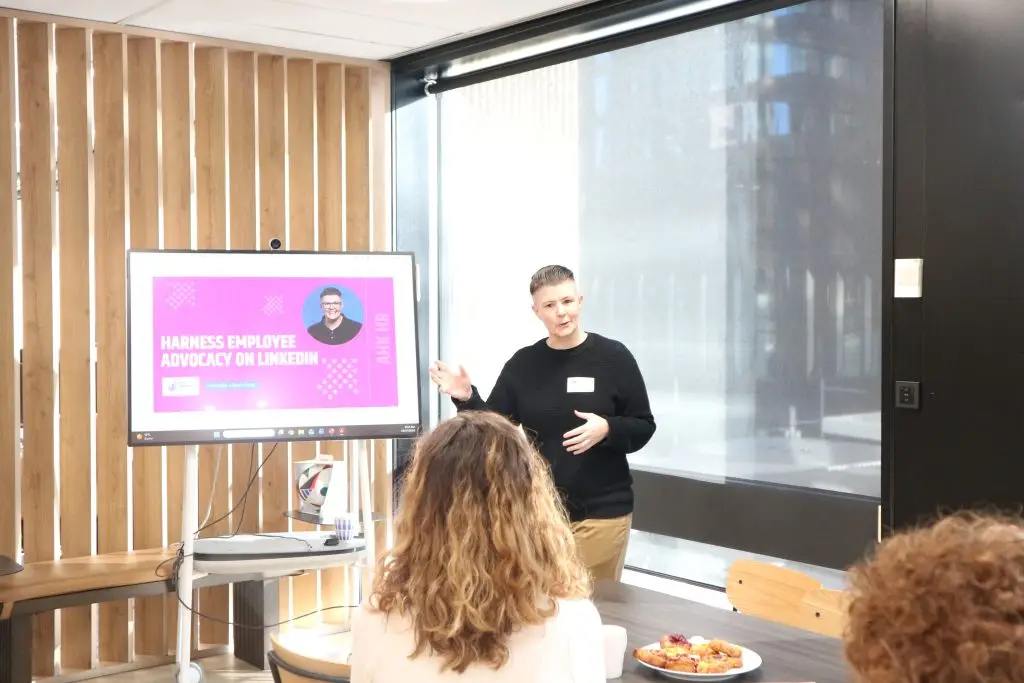
3. Start with willing employees, not everyone
More participants doesn’t automatically mean a stronger employee advocacy program.
Chris has tried the large-scale approach before, including programs where every employee was given licences and expected to post a certain number of times each week.
His conclusion?
“Never again will I do that.”
Today, he prefers opt-in programs and a slower rollout.
That makes sense.
Start with employees who:
- Want to participate
- Have useful expertise or experience to share
- Have managers who support them taking part
- Are willing to have conversations, not just broadcast
- See some personal value in building their LinkedIn presence
Then help those people get results.
Tip – grassroots success creates internal proof. When employees start seeing value, they tell other people, and participation can grow more naturally. That’s much stronger than onboarding hundreds of people who don’t really want to be there.
4. Build governance that gives people confidence
Governance can sound like the boring part of social media strategy. But good governance should make it easier for people to participate, not harder.
When you know the right processes are in place to protect the organisation, you can actually push creative boundaries further. Chris Downey – Elastic
At a practical level, your LinkedIn governance should cover:
- Who approves sensitive content
- Where employees go when they’re unsure
- Who has access to your LinkedIn Company Page and other social channels
- What level of access each person actually needs
- How access is removed when someone leaves
- What happens if content needs to be paused quickly
- Clear boundaries around what employees should and shouldn’t discuss
Don’t assume this is already under control.
During one LinkedIn Company Page audit, I found around 25 people listed as Page admins. Five had already left the organisation, including people who still had significant access rights.
These things are easy to miss when everyone’s focused on publishing.
Tip – better content starts with better systems.

5. Stop choosing between the Company Page and employees
Another mistake is treating your LinkedIn employee advocacy strategy as a choice between the Company Page and employees. It isn’t.
Your Company Page and your employees do different jobs.
The Company Page can:
- Establish the organisation’s position
- Communicate consistently
- Create an official source of content and proof
Employees can:
- Add personal experience
- Bring subject matter expertise
- Share stronger points of view
- Connect ideas back to customer conversations
The same idea can appear differently depending on who’s sharing it.
Tip – The Power of Two is where the real magic is at. That’s where Company Pages and people become more powerful together.

6. Measure more than posts and impressions
Employee advocacy programs can also go wrong when success is reduced to reach, likes, shares or how many posts employees publish. Those metrics tell you something. They don’t tell you everything.
Chris looks at who the organisation is actually enabling, including employees trained, executives coached, and subject matter experts helped to build their presence.
That gives you a better set of questions to ask:
- Are executives participating?
- Are employees becoming more confident on LinkedIn?
- Are more subject matter experts contributing?
- Are employees starting conversations with the right people?
- Are employees creating more of their own content?
- Are useful DMs, introductions or customer conversations happening?
- Are people still active six or 12 months later?
Tip – Not everything valuable on LinkedIn will fit neatly into a dashboard. Sometimes one conversation with the right person is worth more than thousands of impressions.
Final Thoughts
For me, the biggest shift is to stop thinking about employee advocacy as getting more employees to post.
The goal is to help the right people build the skills, confidence and relationships to become genuinely useful voices on LinkedIn.
That takes more work than loading content into a platform. But it’s also what makes employee advocacy worth doing.
At the end of the day, you can buy another platform, you can publish more content, and you can give everyone a licence, but you can’t shortcut trust, expertise or relationships.
Is your LinkedIn strategy creating more activity, or is it making your organisation better at LinkedIn? Let me know in the comments.
Cheers!
Michelle J Raymond
PS: Want to hear my LinkedIn updates first? Subscribe to b2bgrowthco.com/newsletter