If your B2B Company Page isn’t growing, it’s easy to blame LinkedIn. The algorithm changed. Organic reach is harder. Employees get more engagement. Personal brands are having their moment. All of that might be true, but it doesn’t tell the whole story.
Because if Company Pages don’t work, how did AtkinsRéalis grow a LinkedIn Company Page to more than 500,000+ followers after starting a new Page in 2023?
To be fair up front, not every B2B brand has access to the same resources, brand recognition, or team size. They don’t.
But the principles behind that growth are what many B2B marketers are missing, and this case study can really show exactly what it takes to grow a LinkedIn Company Page in 2026.
This article is inspired by the recent episode of the Social Media for B2B Growth Podcast hosted by Michelle J Raymond with guest Holly Kerr, which discusses this topic in more detail.
A Page Worth Following Starts With One Important Question
Most marketing and social media teams are under pressure to keep the Company Page active. So the default question becomes: can we post this on LinkedIn?
That is the number one question that sets your LinkedIn Company Page up for failure.
The better question is: why would someone follow this Page?
That was one of the lessons from Holly and the team behind the AtkinsRéalis Page growth. They didn’t just think about what the business wanted to say. They considered what would make the Page worth following in their industry.
A Company Page that works does more than report internal activity. It helps the audience make sense of something. It educates, informs or energises people behind the industry, the problem being solved, or the impact being created.
It also asks what people should feel after reading their content –
- Proud.
- Curious.
- Confident.
- Clearer on the problem.
- More trusting of your expertise.
- More interested in what your people have to say.
That’s very different from using the Page as a bulletin board.
Posting More Isn’t Always The Answer
AtkinsRéalis was once posting upwards of six times a day across a 24-hour period every day, and now they post around twice a day max.
That’s a huge shift, especially inside a large B2B organisation where every part of the business has something it wants shared.
“If your Company Page content is already competing with personal posts, paid posts, boosted content and everything else in the feed, why are you making it compete with itself?” Holly Kerr
Having too much content can have the opposite intended impact and actually water down the messages you need people to remember.
- Not every request deserves a place on the Company Page.
- Not every event needs a Page post.
- Not every campaign update should be pushed into the feed just because someone asked for it.
Sometimes the better option is:
- A leader post
- Employee content
- Paid support
- A newsletter
- A direct message
- A sales enablement asset
- No post at all
Sometimes the right move is to post less, but make each post work harder.
That’s not doing less. That’s choosing the right lever.
No One Cares About These Types of Company Page Posts
One of the easiest ways to turn a Company Page into a bulletin board is to post every event the business attends.
“We’ll be at this event.” “Come and see us at stand X.” “Our team is looking forward to attending.”
Let’s be honest – you don’t read them, and neither does anyone else. They aren’t helping you get a better ROI on your business’s investment in attending.
You have so many better options –
- Share the problem your team is helping solve
- Introduce the experts attending
- Explain why the topic matters now
- Give people a clear reason to start a conversation
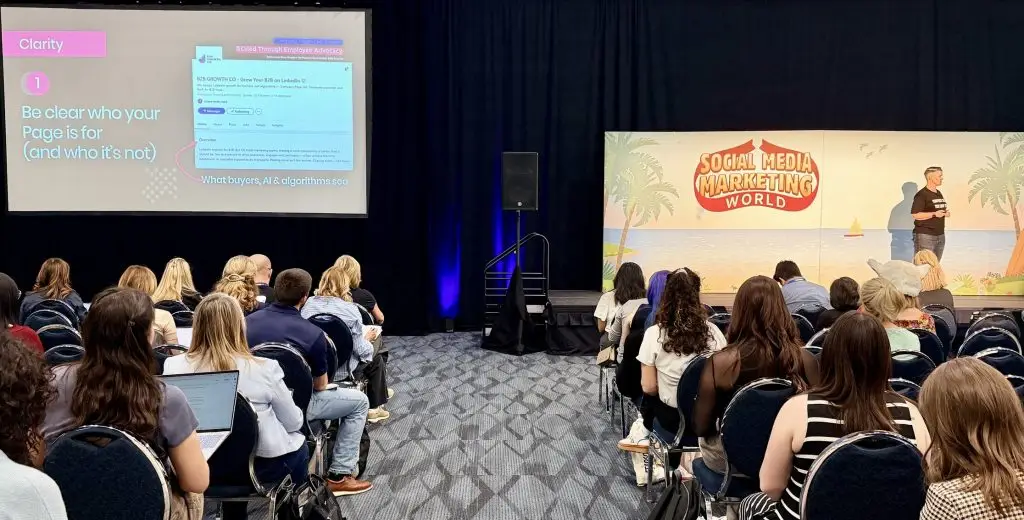
Anyone who came to watch me present at Social Media Marketing World had to promise they would no longer post to the Company Page an entire post(s) that only shares the location of their stand at the next trade show.
Will you make the promise for your Company Page?
Safe Content Is Often Invisible Content
A lot of B2B Company Pages are playing it safe. The posts are polished. The language is approved. The visuals are on brand. The message has probably gone through more rounds of internal review than anyone wants to admit.
Still, nothing much happens. Safe content is just like what all your industry competitors are doing and isn’t getting you anywhere.
Trying something new on a Company Page can feel risky because the brand is visible. Stakeholders are watching. Leadership may be watching. The team doesn’t want to get it wrong. One failed post won’t break the brand.
A post that underperforms is not a disaster. It’s data.
The bigger risk is never learning what your audience responds to because you’re too busy protecting a version of the brand that no one is paying attention to.
Holly said something that made me laugh, as I can totally relate: “The post you pour the most time, love and energy into can be the one that passes by without anyone caring. Then other times you come up with something quickly, with not much thought, and it performs way better.” 🤣
It reminds us that we can overcomplicate content until the reason someone would stop scrolling disappears.
Let’s keep it simple. Before you publish, ask yourself, “Would I care about this if I saw it in my feed?” If the answer is no, your audience probably won’t either.
You know what to do.

Employee Advocacy Takes More Than A Copy-Paste Post
Employee advocacy is one of those phrases that gets thrown around a lot on LinkedIn. The lazy version sounds like this: get employees active, ask them to like and share, give them the approved copy, then watch the reach grow. That’s not employee advocacy.
If you want employees to show up on LinkedIn, you can’t just hand them branded assets and expect them to become advocates overnight. You need to make it easier for them to participate, and you need to trust them to sound like themselves.
That means providing the right support:
- Clear governance
- Social media guidelines
- Training for different levels of confidence
- Examples from people already doing it well
- Permission to add their own perspective
The goal isn’t to create brand parrots. Too many companies say they want employees to post, but what they really want is controlled amplification. They want employees to repeat the company message without adding their own experience or point of view. That’s not what builds trust.
People want real expertise, personal context and useful perspective. They want to see employees who are proud of the work, not employees copying and pasting a corporate line.
Final Thoughts
What I enjoyed most about this conversation with Holly is that the success of this Page was achieved through teamwork, establishing best practices grounded in marketing and social fundamentals rather than hacks, and that the Company Page serves its audience as the priority.
They had to make some tough decisions along the way and really challenge their own views about doing things differently, rather than the way they have always been done.
That’s the kind of courage I’d like to see more of and hear more about.
Have you got a Company Page success story you’d like to share on the podcast? Send me a message and let’s share your key learnings with others so everyone grows.
Cheers
Michelle J Raymond